
You probably know that professional teeth whitening can brighten your smile by several shades in about an hour. But what’s actually happening to your teeth during that time?
The science behind it is surprisingly simple once you break it down, and knowing how the process works will help you understand why professional treatment delivers results that over-the-counter products can’t match.
Why do teeth stain in the first place?
Each tooth has two main layers that affect its colour. The outer layer, enamel, is hard and semi-translucent. It looks smooth to the naked eye, but at a microscopic level it’s covered in tiny pores and has a rod-like crystalline structure with gaps between. Beneath the enamel is the dentine, which makes up the bulk of the tooth and is naturally yellowish.
The colour you see when you look at your teeth is a combination of both layers. Light passes through the translucent enamel and reflects off the dentine underneath.
Over time, pigmented compounds from food and drink, things like coffee, tea, red wine and dark berries, work their way into those microscopic pores and build up within the enamel and at the junction between the enamel and dentine. These pigmented molecules are called chromogens, and they’re what cause the gradual discolouration most people notice with age.

There are also intrinsic stains that form inside the tooth itself, from things like certain antibiotics taken during childhood, trauma, or the natural darkening of dentine as you get older. These behave differently and can be harder to lift.
The teeth whitening process, step by step
Now that you know what’s causing the staining, here’s how a professional session tackles it. At Harley Teeth Whitening, the whole appointment typically takes 30 to 60 minutes:
- Consultation and shade assessment. The dentist checks your suitability, takes a shade sample using a VITA guide, and shows you what results you can realistically expect. Any existing dental work, sensitivity or gum concerns get flagged during this initial stage.
- Cleaning and preparation. Your teeth are cleaned with an activator solution to remove surface debris and plaque, so the whitening gel makes direct contact with the enamel.
- Gum protection. A protective barrier is applied to shield the gums from the concentrated hydrogen peroxide gel.
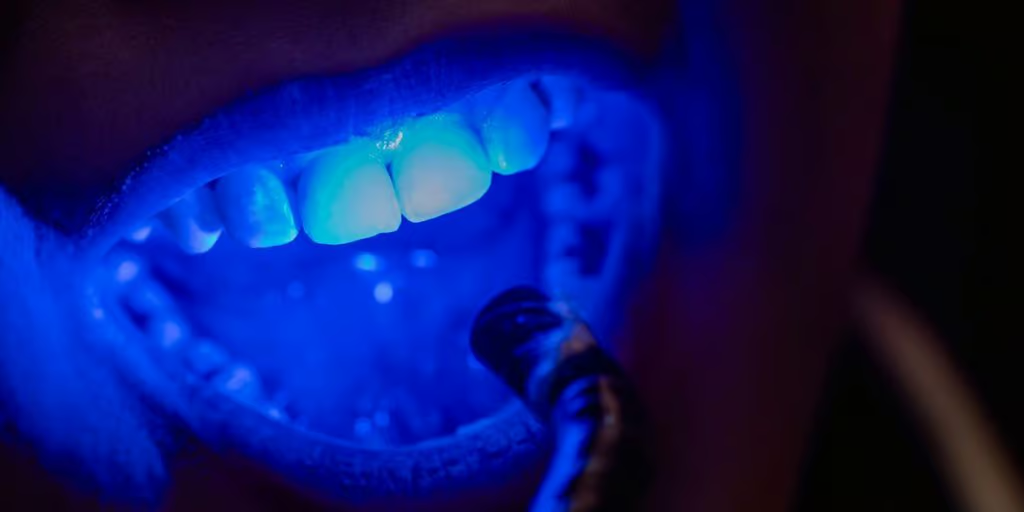
- Gel application and LED activation. The whitening gel is applied evenly across the front surfaces of your teeth, and a Blue Spectrum LED light is positioned to accelerate the process. Treatment is carried out in two or three cycles of 15 to 20 minutes each, with the gel reapplied between cycles.
- Results recorded. The gel is removed, your new shade is recorded, and you’ll see the difference immediately. Most people see an improvement of six to eight shades in that single session.

How does the teeth whitening gel break down stains?
The gel used in professional whitening contains hydrogen peroxide as its active ingredient. In the UK, dentists are permitted to use concentrations of up to 6%. Over-the-counter products, by contrast, are limited to just 0.1%, which is why the difference in results is so significant.
When the gel is applied to your teeth, it begins to break down into water and oxygen. That oxygen is the key part. The molecules are small enough to pass through the porous enamel surface and reach the stained compounds trapped within the tooth structure. Once there, they react with the chromogens through a process called oxidation, which breaks apart the molecular bonds that give those stain compounds their colour.
As these bonds break, the stain molecules become smaller, lighter and less visible. The tooth itself isn’t being bleached in the way you might bleach a shirt. The structure stays intact. What changes is the colour of the organic compounds trapped within it.

This is also why whitening only works on natural teeth. Crowns, veneers and fillings are made from synthetic materials that don’t have the same porous structure, so the peroxide can’t penetrate them. If you have visible restorations, they’ll stay the same shade while your natural teeth lighten around them.
What does the LED light actually do for teeth whitening?
The Blue Spectrum LED light you see during treatment doesn’t whiten your teeth on its own. What it does is accelerate the chemical reaction that’s already happening in the gel.
The light operates at a wavelength of around 450 to 490 nanometres, which falls in the blue part of the visible spectrum. At this wavelength, it provides energy that speeds up the breakdown of the hydrogen peroxide molecules, causing them to release oxygen faster and more evenly across the tooth surface.
The whitening gel would eventually do its job without the light, given enough time. The LED just makes that process happen much faster within a controlled treatment window. It’s an accelerant, not the whitening agent itself.
Modern LED systems don’t generate significant heat, either. Older UV-based lights used to raise the temperature around the teeth, which could cause discomfort and carried a small risk of irritating the pulp inside the tooth. Blue LED technology avoids that entirely, which is one of the reasons it’s become the standard in professional clinics.
How long do teeth whitening results last?
Professional whitening results typically last between 12 and 24 months, depending on your diet, habits and how well you maintain them. Your teeth will naturally pick up new stains over time from everyday food and drink, but the rate at which that happens varies from person to person.
Avoiding heavy staining in the first 48 hours after treatment makes a real difference, because the enamel pores are temporarily more open and absorb pigments more readily during that window. After that, simple habits like rinsing with water after coffee or tea, following proper aftercare advice and keeping up with regular dental hygiene will help your results last as long as possible.
When your teeth do eventually start to fade, a single touch-up session can bring them back. Most people find that touch-ups are quicker and require less intensive treatment than the original appointment, because you’re only reversing a few months of new staining rather than years of build-up.
Want to see how teeth whitening would work for your smile? Book a free consultation at our Marylebone clinic for a shade assessment and results preview before you commit.